Cycling Through Mazovia with Five Kids and a Cargo Bike
← All postsSeven people, five bikes, five kids and 267 kilometres through eastern Mazovia. Temperatures reaching 38°C, a serious thunderstorm, a ferry across the Vistula, swimming along the way and wake-up calls before five in the morning. We ride from Józefów through Stoczek Łukowski, Dęblin, Słowiki, Maciejowice and Łaskarzew, sleeping in tents and carrying all the gear we need. Six days of family bike touring, during which we discover that with kids, the riding itself can be easier than the stops — and that a good plan is, above all, one you can change along the way.
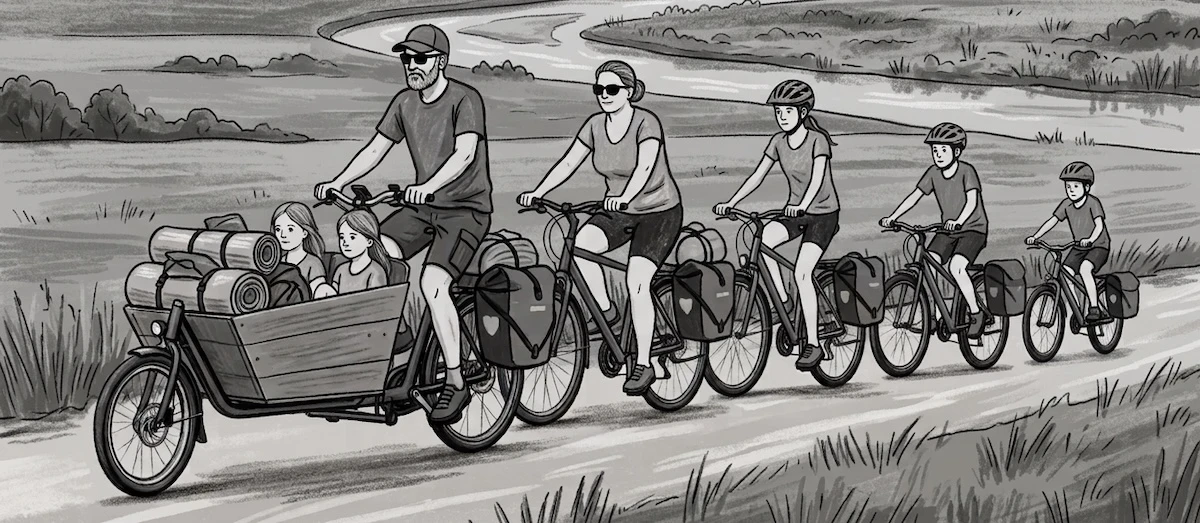
Setting off
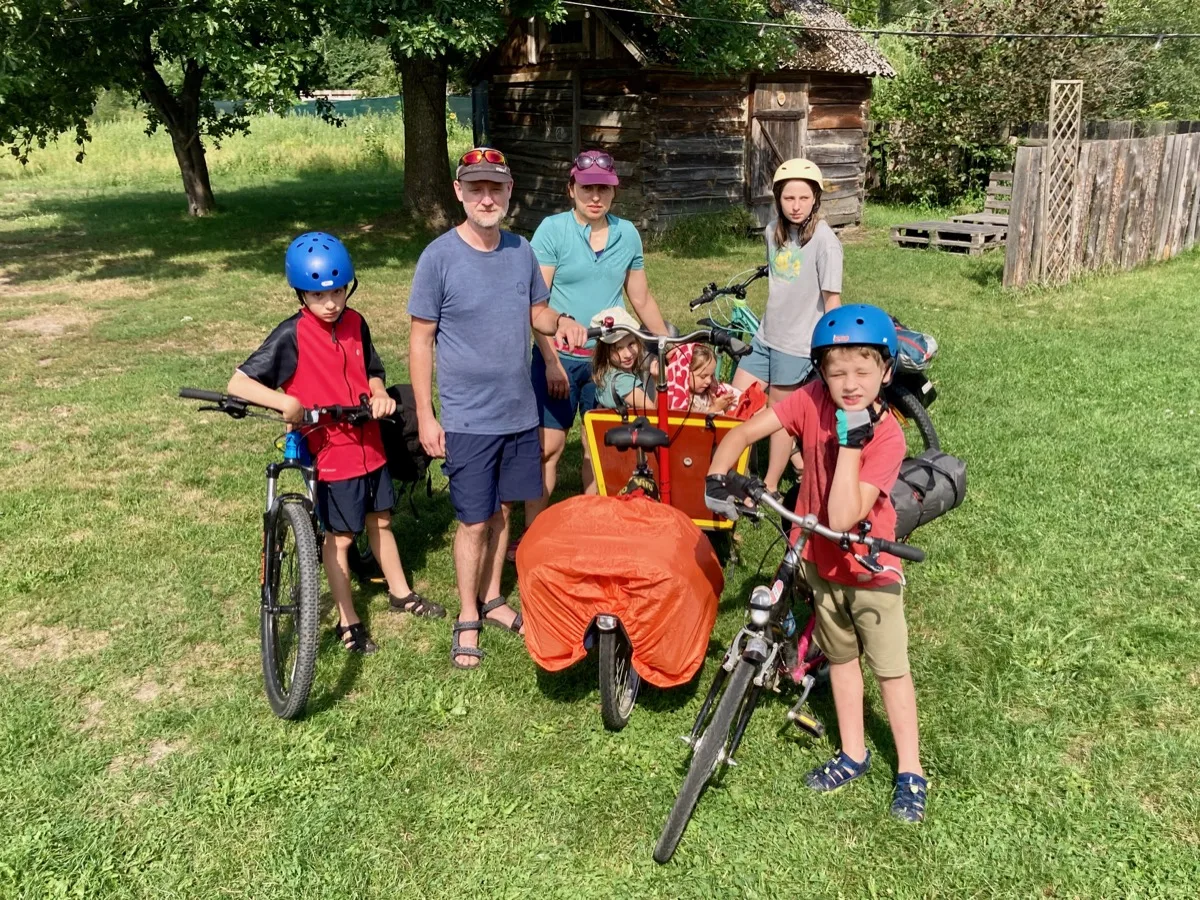
On August 1, the whole family sets off on a cycling loop through Mazovia. Agnieszka, Ewa, Bruno and Stefan ride their own bikes; I'm on a cargo bike — a bakfiets — with the two younger girls. We're carrying tents, sleeping gear, basic cooking equipment and home-preserved food for the first two days.
The plan is simple: ride through eastern Mazovia, camp near Stoczek Łukowski, look for the source of the Świder River, spend a night at a glamping site in Podebłocie, continue to Wyspa Wisła and Dęblin, stop at the grandparents' place in Słowiki, then take the ferry across the Vistula at Świerże and return to Józefów via Łaskarzew and the Wilga valley. It's not an obvious tourist destination. There isn't much infrastructure, but that's part of the appeal: seeing places well off Poland's tourist map that we'd otherwise have little reason to visit.
We split the luggage between all the bikes. Agnieszka and Ewa have two panniers each, while the boys have one each. Bruno and Stefan each carry a tent, and Ewa also carries two picnic blankets. The bakfiets mostly gets the bulky but relatively light stuff: swimming gear and extra water, while its panniers hold two sleeping bags, two self-inflating mats and a foam sleeping mat.
We have two tents, one for three people and one for four. The girls sleep in the four-person tent on the mats, covered with unzipped sleeping bags. I sleep with the boys in the three-person tent on a picnic blanket, with another one over us. The nights are supposed to be warm, so that should be enough.
Day 1 — Stoczek Łukowski
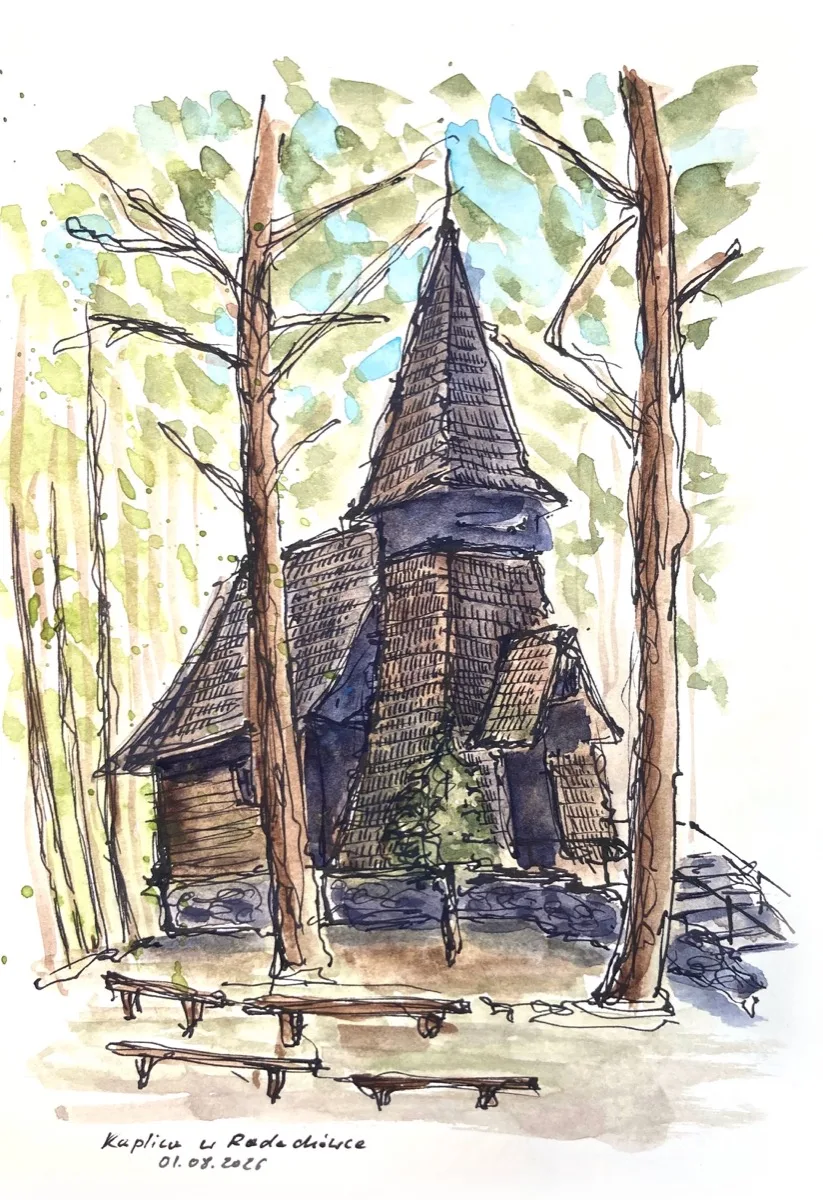
We set off after 8 a.m., riding through Kopki and past the weir in Wola Karczewska. Our first stop is at a playground, and eight kilometres later we stop for ice cream in Sufczyn. Then there's another break by a wooden chapel in Radachówka.
It quickly becomes clear that riding an unassisted cargo bike over long distances is a completely different proposition from riding a regular touring bike with panniers. I'd estimate the effort at about one and a half times as much. The upright riding position and very soft city saddle, perfectly comfortable for a few kilometres around town, lose out to a more athletic position over longer distances. Then there's the weight and the city gearing. Uphill, it's very hard work. Downhill, on the other hand, the bakfiets is magnificent.
It's getting hot. Stefan is struggling. We take a longer break by the roadside because everyone is already tired. Afterwards things improve considerably and the riding feels good again.
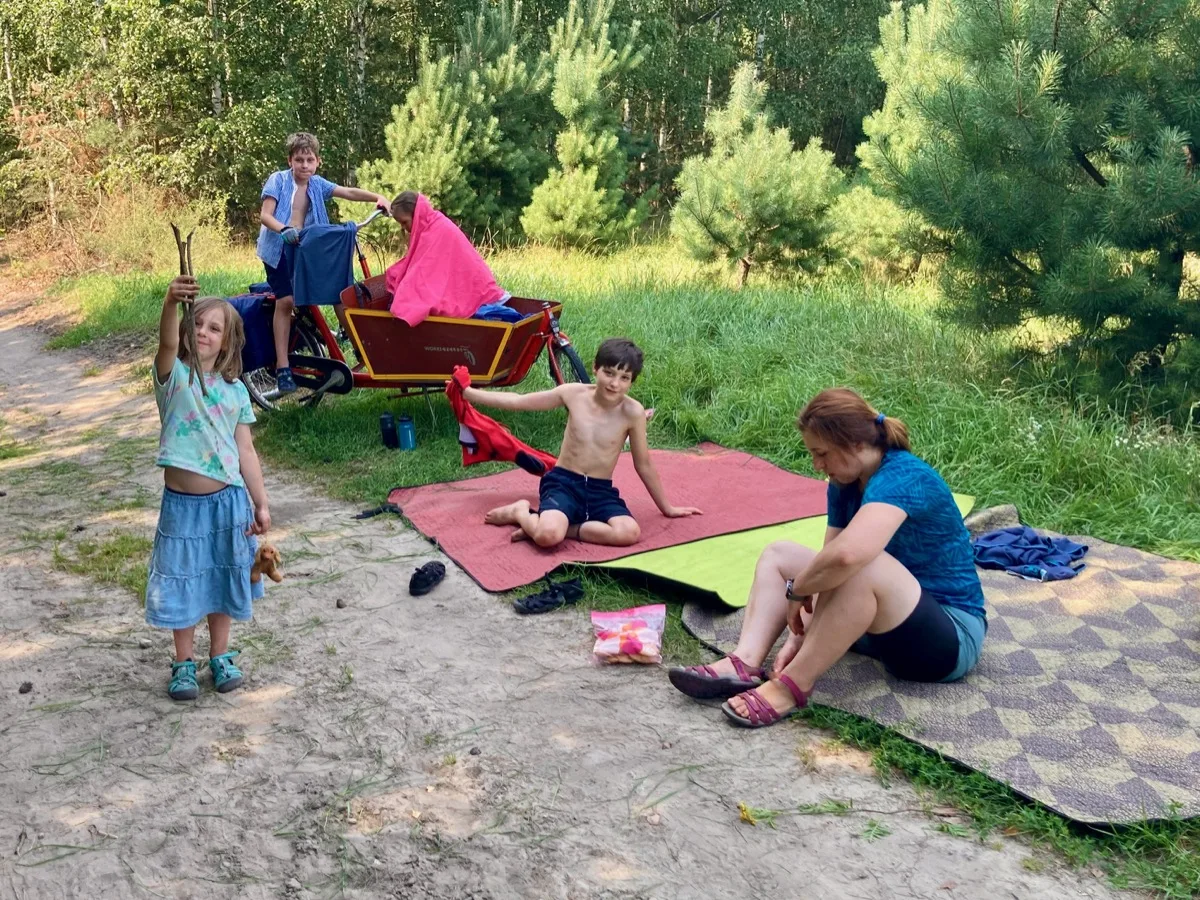
The girls are enjoying the journey. They sit in the box in front of me, don't complain, watch the world go by and chat with me. Daria is particularly fascinated by corn and manure. She also counts the fire hydrants we pass. Ula likes the trip, although she points out that she wouldn't necessarily want to do this much pedalling herself. She'd rather lie in a meadow and smell the flowers. For now, she picks flowers at every stop and hands out bouquets to everyone else.
Paradoxically, the stops are the hardest part. While we're riding, everyone has one specific job: ride. Once we stop, the parenting begins. The older kids are tired, so they complain or argue. The younger ones are the opposite — they've spent the past hour sitting in the cargo-bike box, so they're full of energy. You'd like to sit down and rest, but instead there are children, arguments, food, luggage and gear to deal with.
Ewa just gets on with it, often riding by herself at the front, sometimes with Bruno. She doesn't complain, doesn't get drawn into arguments as much during stops, and doesn't need much attention. She's already done several trips like this and simply knows what to do.
Towards the end of the day, a serious thunderstorm arrives. First we shelter under a roof, then twice more at bus stops. When it passes, everything changes. The air turns fresh and the wet road steams. There are broken branches everywhere and a rainbow appears in the sky.
We ride through forests, broad meadows and villages. The harvest is underway and combine harvesters are working in the fields. We pass storks, deer and cows. Everything is flowering and fragrant. The roads are excellent and almost empty.
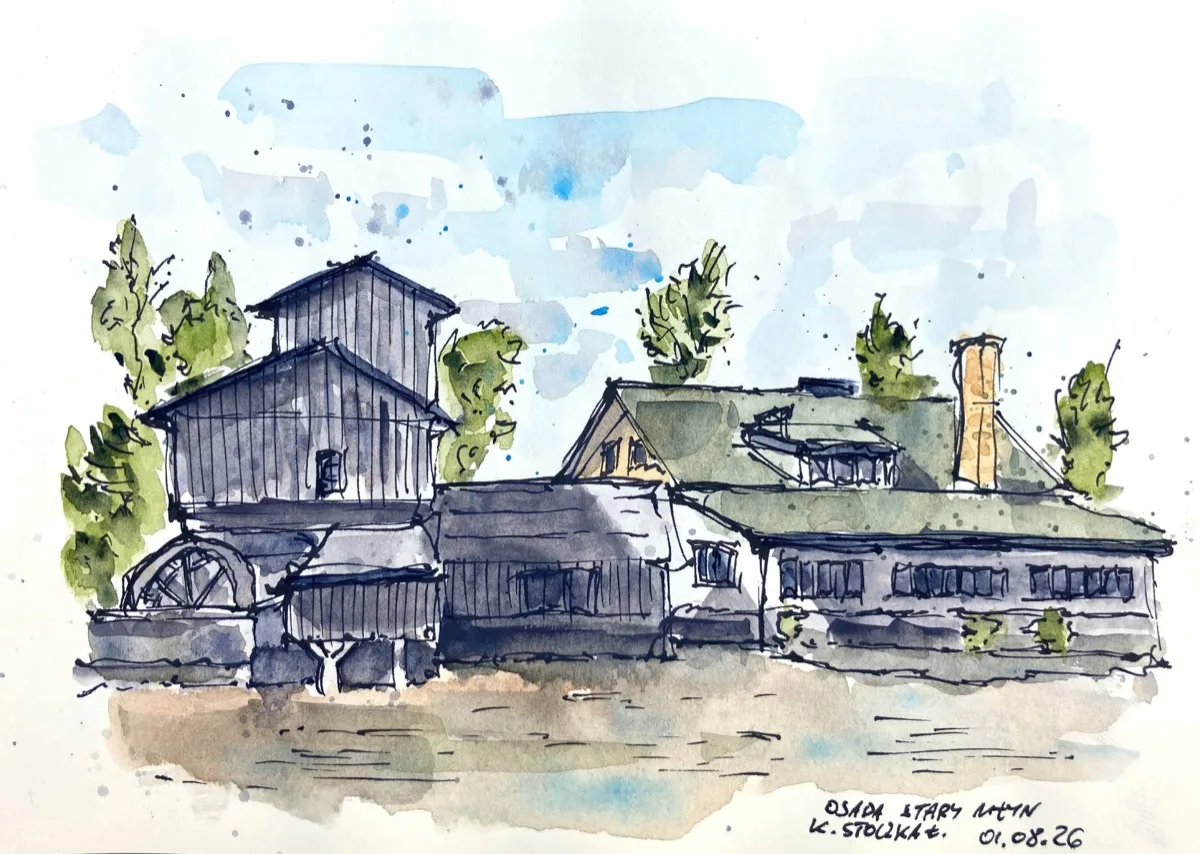
Our overnight stop at Stary Młyn near Stoczek is peculiar. The place looks as if its glory days were sometime in the 1990s. The owner is rather odd as well, and his constant presence feels a little awkward. Still, there's somewhere to pitch our tents, take a shower and heat up dinner, and at the end of the day we reward ourselves with some Coke.
We've completed the longest stage of the trip: 68 kilometres.
Despite the tiredness, everyone has really enjoyed the day.
Day 2 — Podebłocie
Another light thunderstorm passes during the night. The tents aren't completely dry in the morning, but more importantly, nobody looks particularly tired after the first day. Everyone is ready to keep going.
At nine we go to Mass in Stoczek. Afterwards we change clothes in the market square and set off towards the source of the Świder River.
The riding is surprisingly smooth. There's some cloud cover, so the heat isn't bothering us. The roads are larger and busier than the day before, but it's still pleasant riding.
Around Jagodne and Świder we encounter the first small streams that eventually form the Świder River. They look rather like narrow, overgrown drainage ditches. We don't make it all the way to the actual springs, as that would require wading through tall grass deep into the meadows.
In Żelechów we stop for ice cream, but wasps quickly put an end to the break. We pack up and continue.
Near Trojanów, the girls are starting to get tired of sitting in the box. We put some music on for them and the problem disappears for a while.
The biggest navigational mistake of the day awaits us in Podebłocie. The settlement is incorrectly marked on the map. We ride down a long, steep hill only to discover that we have to go straight back up the same way. Four bonus kilometres — plus the climb back up the hill we've just descended.
Eventually we reach Siedlisko Stasin, our glamping site. We'd been here by bike two years earlier with Ewa and Bruno. Since then, the barn has been converted into a common room, everything has become a little more overgrown, and there's a new swimming pool.
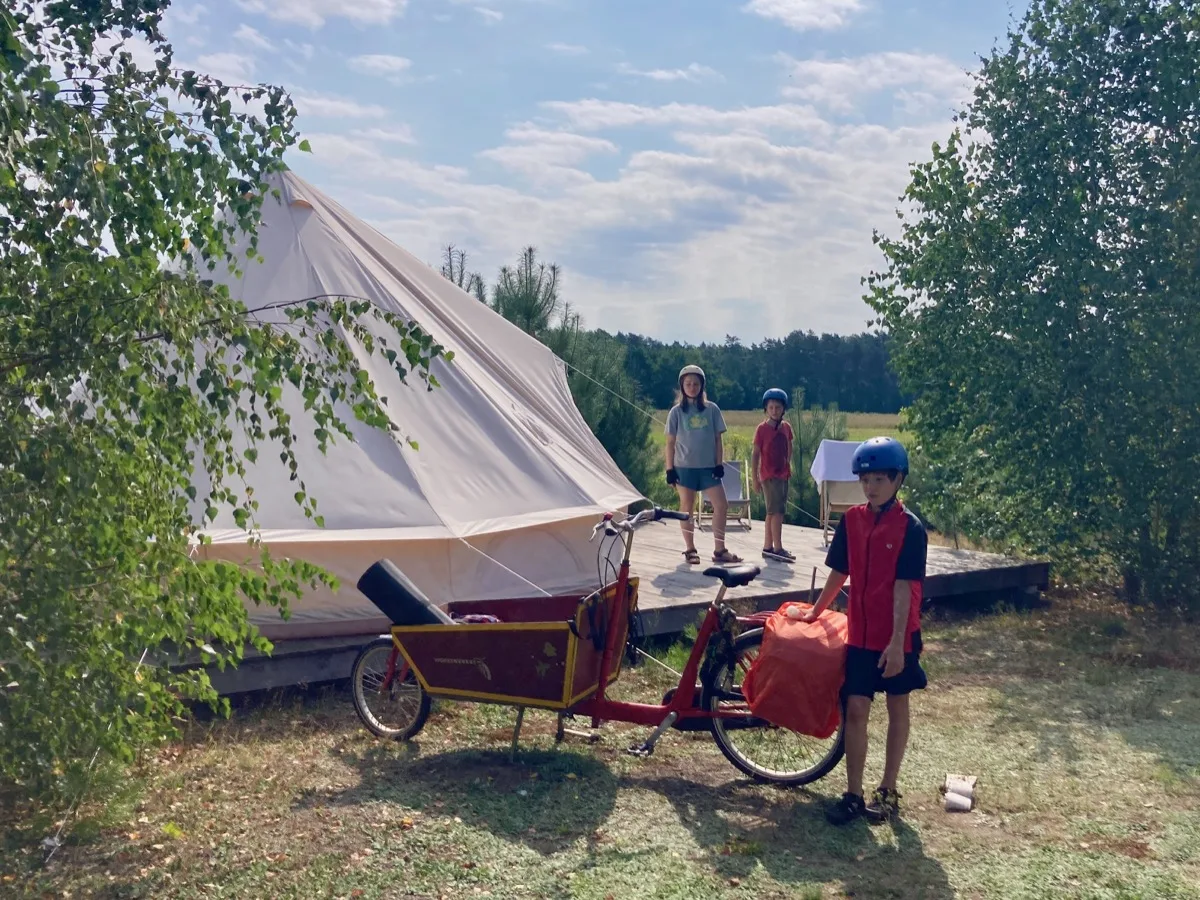
Lunch is spaghetti from one of our own jars. The preserved meals work brilliantly: instead of organising cooking for seven people, we open a ready-made meal and heat it up.
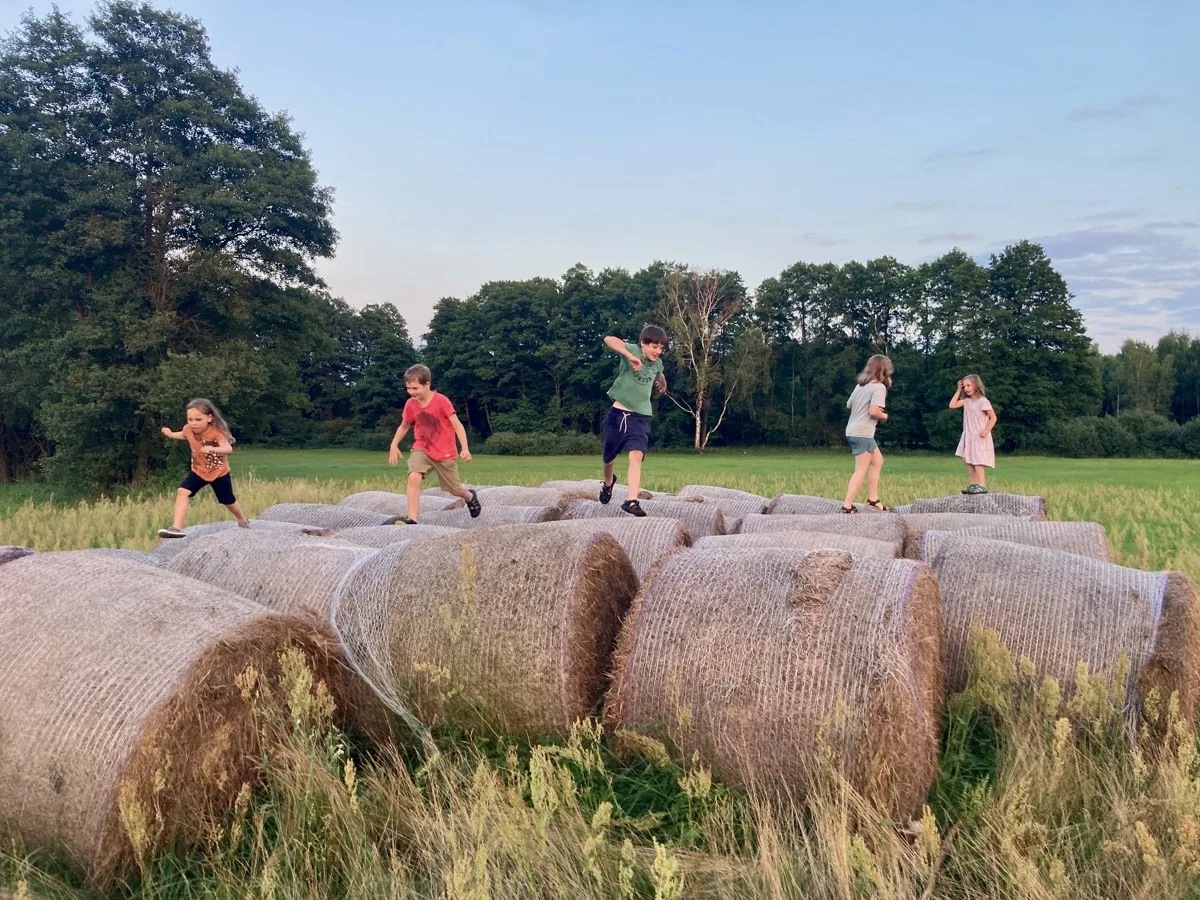
We sleep comfortably in two glamping tents with proper beds and furniture. In the evening we take a walk through a nearby ravine with a picturesque little stream at the bottom, although Stefan isn't particularly impressed. On the way, we play tag on hay bales.
Day 3 — Słowiki
It's only 35 kilometres to the grandparents' place in Słowiki. But it's hot.
We ride mostly on larger roads as far as Stężyca, but there's plenty of downhill, so the kilometres pass quickly. About halfway there, we stop at Wyspa Wisła.
This is a proper break. We swim in an oxbow lake — everyone except Agnieszka — mess around in the water and escape the heat. I also get out the tiny camping stove and make coffee. Coffee brewed on a little stove somewhere along the road is one of those small pleasures that makes carrying a bit of extra gear worthwhile.
Then we follow a picturesque embankment along the Vistula towards Dęblin, before continuing on gravel roads through Łoje towards Mozolice.
The girls are beginning to struggle with the heat. For a change, they spend some time riding on the rear racks.
During one of our short stops, Stefan and Bruno get into a fight. Nobody is entirely sure what started it, but it ends with an attempt to push Bruno, bike and all, off the road. I have to intervene. From Mozolice onwards, at least, we get a tailwind.
In Słowiki there's a swimming pool, dinner and ice cream waiting for us. Later the kids watch The Hobbit, while Agnieszka and I ride to Garbatka to visit Grandma, Zuzka and Adam.
We were supposed to continue the next day, but we change the plan. We have time to spare and everyone would appreciate a rest. If we'd followed the original plan, we'd barely have had time to stop before packing up all our stuff again and getting back on the road.
So we stay for another day.
Day 4 — Słowiki
It's hot.
The grandparents take the older kids to Kozienice for some shopping and swimming. Bruno has a stomach ache, so he spends most of the day lying down or sleeping.
We stay with the girls. We spend most of the day in the pool.
After three days of riding, that suits us perfectly.
Day 5 — Rębków-Parcele
The forecast says temperatures could reach 38°C. There's no point trying to ride normally in that kind of heat. We decide to leave at dawn and reach a campsite on the Wilga River before it gets seriously hot. After that, the plan is simply to sit in the river.
In the evening we pack everything we can. The alarm goes off at 4:40. At five, we're ready to ride.
Bruno still isn't feeling well. He does a test lap around the yard. Until the last moment he's unsure whether to come, but eventually decides to stay with his grandparents.
We leave without him.
We ride through Kępeczki, on a mixture of paved and gravel roads. The sun is only just coming up. After yesterday's heat, the cool morning air is soothing. Empty roads, meadows, fields and birdsong. The girls doze in the bakfiets.
Ula complains that her stomach hurts. We're worried she's coming down with the same thing as Bruno. But after a while it passes, so we continue.
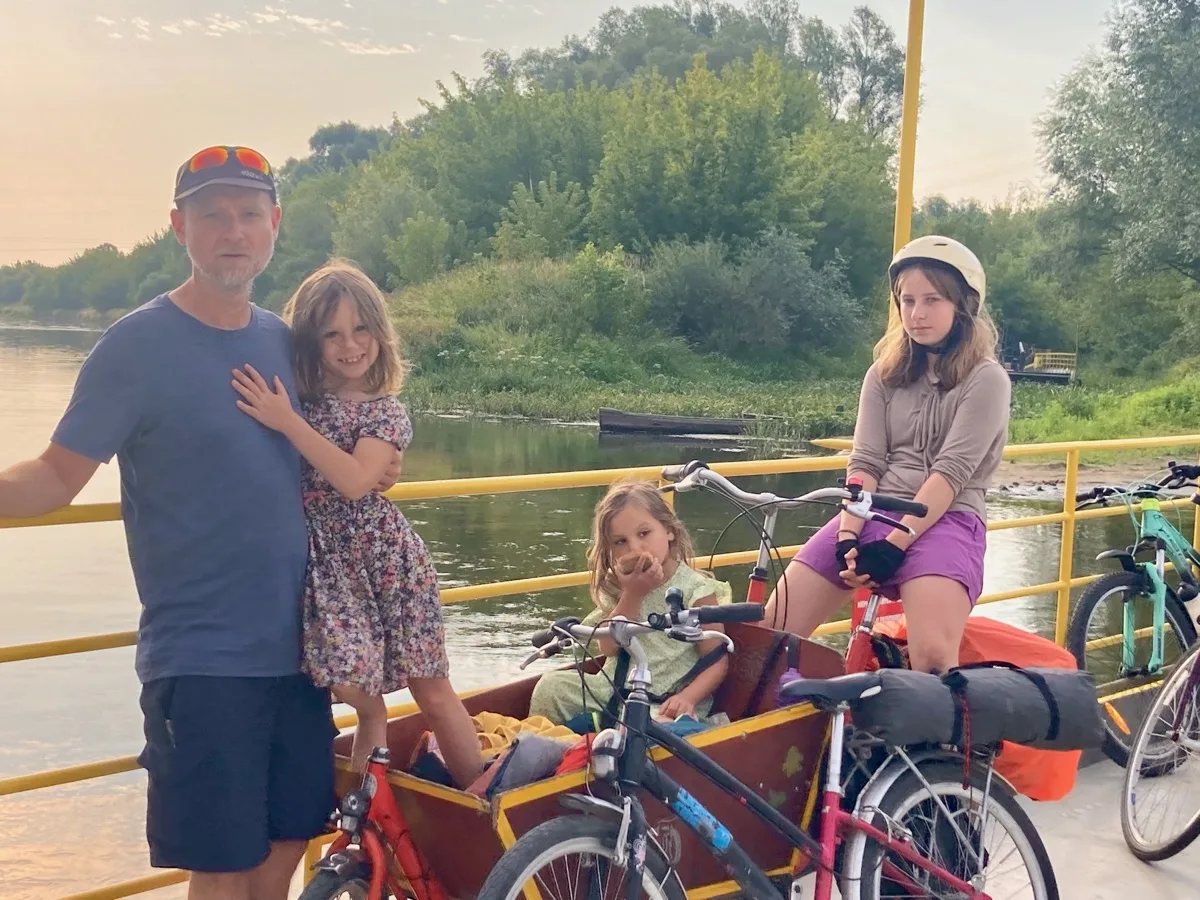
The Kozienice power station grows larger in the distance. We reach the ferry and cross to the other side of the Vistula. There we have breakfast on the river embankment beside a meadow.
We deliberately move farther along the embankment to get away from a dog barking at a nearby farm. Ula goes to pick flowers. Naturally, the prettiest ones are right next to the fence, so the dog keeps barking anyway.
We ride through Maciejowice to Łaskarzew. There's a little more traffic, but we make good progress. In Łaskarzew we stop for pizza and ice cream.
Ten kilometres to go. By now, the heat is intense.
At around eleven we reach the campsite in Rębków-Parcele. The owners show us around their private museum of old objects and sell us some eggs. The plan has worked: we can spend the hottest part of the day in the Wilga.
And that's exactly what we do. The rest of the day is spent almost entirely in the river.
The night is so warm that we sleep in the tents without the rainflies.
Day 6 — Józefów
Once again, we leave early. By six we're on the road, hoping to cover as many kilometres as possible before the heat sets in.
We take minor roads, mostly paved. As usual, Ewa is somewhere up ahead. We eat breakfast in a clearing in the forest.
Suddenly we're caught by a short burst of rain, seemingly from nowhere. After spending the previous day trying to escape 38-degree heat, it's a rather unexpected change.
We make one more short stop in Celestynów. Daria goes wild.
But we can already feel that the trip is ending. Nobody is particularly interested in extending the stops anymore. We pack up quickly because now we simply want to get home. Stefan is tired.
At eleven, we're back in Józefów.
Six days away, five days of riding, 267 kilometres covered.
What worked
Our average speed was about 15 km/h. We divided each day into stretches of roughly 15–20 kilometres, and that turned out to work very well. The sections were long enough to make visible progress on the map, but not so long that the kids got fed up with riding. After each one there was a proper break: ice cream, swimming, a playground, food, or simply sitting by the roadside.
We carried around five litres of water in our bottles, plus an additional five-litre container. In that kind of heat, the reserve was definitely useful.
Our cooking kit consisted of a tiny camping stove, a small pot, seven mugs, four metal plates, a few paper plates and cutlery for everyone. Some of it was there as backup. In the end, we never used the pot or the paper plates, and we didn't need all the mugs either. Every campsite had pots, plates and cutlery available. The mugs were mainly useful for coffee made on the road.
Essentially everything we brought turned out either to be useful or at least sensible to have as a precaution. There wasn't much that made us wonder afterwards why we'd bothered carrying it. The only thing we occasionally missed was a camping clothesline for drying clothes and towels.
The biggest discovery, however, wasn't about equipment.
Travelling by bike with children is strange in that the riding itself can be the easier part. When everyone is on their bike, everything works. Everyone knows what they're supposed to do.
We ride.
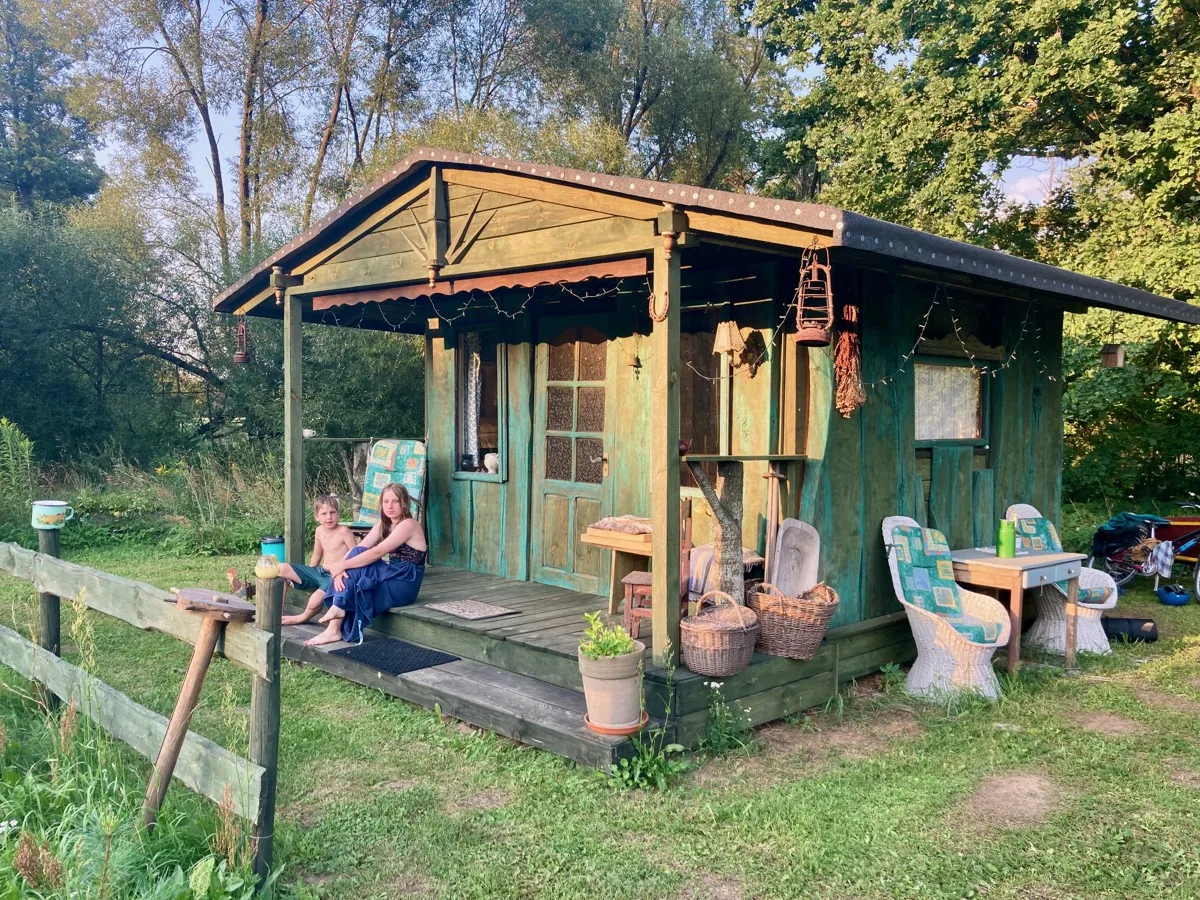
Things get harder when, theoretically, it's time to rest. You have to find things in the panniers, unpack, pitch the tents, make food and make sure nothing gets lost. The older kids have just ridden several dozen kilometres, so they're tired. The younger ones have just travelled several dozen kilometres sitting comfortably in the bakfiets, so they're bursting with energy.
But the system works.
Fifteen or twenty kilometres of riding, a stop, then another fifteen. If it's too hot, we leave at five in the morning. If everyone needs a rest, we change the plan and stay an extra day. If Bruno isn't feeling well, he stays with his grandparents. The plan turns out to be more of a starting point than something that has to be followed at all costs.
So when we get home, the obvious question is: would we do it again?
Everyone except Daria says yes.